The Wayzata boys soccer team won the Section 6AAA championship Tuesday, defeating Minneapolis Washburn in a penalty-kick shootout to reach the Class AAA state tournament for the fourth time in five seasons.
The Trojans rallied from behind twice during regulation. Washburn’s Lucas Neu scored both of the Millers’ goals, including one with 3:44 remaining that gave Washburn a 2-1 lead.
Preston Williams tied the match for Wayzata with 2:06 left. After two scoreless overtime periods, the Trojans won the shootout 3-2, with Bennett McCain converting the deciding kick.
Watch the CCX Media highlights above. CCX Media reported the October 21 result, with John Jacobson covering the match. Video and featured image courtesy of CCX Media.
The Wayzata girls soccer team advanced to the Class AAA state tournament for a sixth consecutive season Tuesday after defeating Minneapolis Washburn in a 10-round penalty-kick shootout in the Section 6AAA final.
The Trojans and Millers finished regulation tied 2-2 and remained even after a 20-minute overtime period. Wayzata prevailed 9-8 on penalty kicks, with Nora Gengerke converting the deciding attempt in the tenth round.
Mackenzie Daneman and Ava Molde scored Wayzata’s two goals in regulation.
Costumed runners will return to Lake Street on Saturday, Oct. 24, as Wayzata’s Boo Bash Dash brings races, a Pumpkin Derby and Halloween contests to downtown. Boo Blast trick-or-treating will follow at participating businesses from 11 a.m. to 2 p.m.
Costumed runners take off at a previous Boo Bash Dash in Wayzata. Photo supplied by the Wayzata West Metro Chamber.
The race schedule begins with the 10K at 9 a.m., followed by the 5K at 9:15 a.m. The competitive Lake Street Mile starts at 10:30 a.m., with cash prizes for the top three male and female finishers. A one-mile Family Fun Run begins at 10:40 a.m. Strollers are permitted.
Organizers say the 10K, 5K and Lake Street Mile are USATF-certified. Costumes are encouraged for participants.
Costumed participants make their way along Lake Street at a previous Boo Bash Dash. Photo supplied by the Wayzata West Metro Chamber.
At 11 a.m., homemade pumpkin racers will compete in the Pumpkin Derby near the Great Lawn stage. Participants must bring their own pumpkins; wheel kits can be selected through registration. Prizes will recognize speed and creativity.
A pumpkin pie eating contest is scheduled for approximately 11:15 a.m., during the derby intermission. A costume contest also offers prizes, with check-in on race day.
Pumpkins on wheels race down the ramp at a previous Boo Bash Dash Pumpkin Derby. Photo supplied by the Wayzata West Metro Chamber.
Benedict’s will offer breakfast food on the Great Lawn. According to the Chamber’s announcement, Red Cow Wayzata will offer a free beer with a race bib at its restaurant on Oct. 24.
Families joining Boo Blast can begin and end their trick-or-treating route wherever they choose. Participating stores and restaurants will display trick-or-treat signs in their windows. Lunds & Byerlys Wayzata, at 1151 Wayzata Blvd. E., will also hold its Boo Blast from 11 a.m. to 2 p.m.
Kent Peter Howe, 92, of Wayzata, died Wednesday, October 7, 2026. He and his wife, Marylyn, celebrated their 65th wedding anniversary this year.
Howe was born April 20, 1934, in Bemidji, Minnesota, to Paul and Mollie (Whalen) Howe. He graduated from Bemidji High School and studied mathematics and economics at St. John’s.
Following the Korean War, Howe served in Japan as a military codebreaker, contributing to U.S. intelligence work during the early Cold War. He later attended graduate school at the University of Illinois at Urbana-Champaign, studying to become an actuary.
He moved to New York to work for New York Life, where he met Marylyn. They married in 1961 and raised three children.
According to his family, Howe enjoyed spending time with family and making new friends. He played bridge and golf, watched sports and enjoyed telling dad jokes.
Howe coached and managed his children’s youth sports teams, served as an officer in the Lions Club and volunteered as an usher and Eucharistic minister at the Church of St. Bartholomew in Wayzata.
Before joining the Charter Commission, Howe served on the Planning Commission, which reviews land-use and development matters. Wayzata.com’s December 2008 City Council coverage documented his involvement in that commission.
When the Wayzata City Council recognized Howe at its January 6, 2026, meeting, Mayor Andrew Mullin described him as “a fixture in and around boards and commissions probably for the last 30 years.” Mullin also noted Howe’s institutional knowledge and long service to the city.
Howe is survived by his wife, Marylyn; their three children, Kaaren Howe (Leilani Hotaling) of Ely, Kathleen Prouty (Jim) of Plymouth and Kent Howe Jr. (Sue) of Shoreview; eight grandchildren, Kira Howe Hotaling, Ketki Varsha, Eric Prouty (Rowan), Jamie Prouty (Isaac), Kelly Prouty (Tyler), Pete Howe, Josh Howe and Andrew Howe; and one great-grandchild, Cainan.
He is also survived by his twin brother, Kevin Howe (Mary Ann), and many nieces and nephews.
He was preceded in death by his parents, Paul and Mollie Howe; his brother, Bill Howe; and his sister, Helen Mary Wagner.
A Mass of Christian Burial was scheduled for 11 a.m. Friday, October 23, at the Church of St. Bartholomew, 630 E. Wayzata Blvd., in Wayzata. Visitation was held Thursday, October 22, from 5 to 7 p.m. at Gearty-Delmore Funeral Chapel, 15800 37th Ave. N., in Plymouth, with additional visitation scheduled for the hour before Mass.
His grandchildren were designated as pallbearers. Private interment is planned at Fort Snelling National Cemetery.
The family prefers memorial contributions to Interfaith Outreach & Community Partners. Additional information is available through Gearty-Delmore Funeral Chapels.
Robert Charles Fisher, the Wayzata shoe repairman known to generations of residents as “Shoe Bob,” who started what became the Interfaith Outreach Sleep Out, died October 1, 2026. He was 78.
Bob Fisher. Submitted photo previously published by Wayzata.com.
Fisher spent decades at Bob’s Shoe Repair, first in the former Wayzata Bay Center and later at Colonial Square. Customers brought him shoes, boots and other leather goods to repair.
Born August 30, 1948, Fisher grew up in Anoka and spent portions of his childhood in St. Michael and Montrose. After high school, he served in the United States Navy, leaving the service in November 1970.
He worked at a shoe store in Anoka for 25 cents an hour plus room and board. Later, he traveled between towns collecting shoes for repair and returning them to customers. He eventually made his way to Wayzata.
From 1972 to 1980, Fisher managed the shoe repair operation at The Foursome in the old Wayzata Bay Center. In May 1980, he purchased the business from the Engel family and established Bob’s Shoe Repair.
When the Bay Center was slated for demolition in 2008, Fisher moved the shop uphill to Colonial Square. He sold it to Dave and Becca Young in May 2015. The shop kept his name.
Bob Fisher in a 2009 Wayzata.com archive photograph.
One tent in a Wayzata front yard
In 1995, Fisher decided to spend a winter night outside.
In a 2020 interview with Bethel University journalism students Miranda Erbele and Kadrian Chambers, Fisher recalled pitching a bright yellow North Face tent behind his Wayzata home. At first, he simply wanted to see whether he could make it through the night.
That night, Fisher said, he felt called to move the tent into his front yard and use it to help others. He had seen families visiting the Interfaith Outreach food shelf and wondered how they would pay for Thanksgiving dinner.
Fisher set a goal of raising $7,000, enough to provide Thanksgiving meals for 100 families. He shared the idea with customers at his shoe repair shop, and donations began arriving.
Interfaith Outreach founder LaDonna Hoy recalled in 2012 that Fisher brought in $10,000 that first year. Hoy encouraged him to do it again the following winter, this time raising money to help families facing homelessness.
Fisher slept outside about 270 nights over the next 11 years, according to the 2020 account. The annual Sleep Out became an Interfaith Outreach & Community Partners campaign.
Students, families, churches, community organizations, and businesses began holding their own sleep outs. Tents appeared outside homes, schools, and places of worship throughout the western suburbs.
Minnesota Twins players Corey Koskie and Joe Mauer were among those who spent nights outside with Fisher, sometimes in subzero temperatures.
The Sleep Out in 2008. Wayzata.com file photo.
Recognition in Congress
On April 25, 2002, U.S. Rep. Jim Ramstad paid tribute to Fisher on the floor of the House of Representatives. Ramstad reported that Fisher’s sleep outs had raised more than $1 million during their first six years, including $520,000 during the preceding winter.
The congressman recalled joining Fisher for a night outdoors in December 1997, when temperatures dropped below zero.
Ramstad also described the 2001 Sleep Out kickoff in Wayzata, when more than 500 supporters gathered. Girl Scouts served soup, bread, and hot chocolate, Boy Scouts maintained four campfires along Lake Street, and approximately 200 young people joined Fisher in spending the night outside.
By early 2014, the Star Tribune reported that the Sleep Out had raised more than $19 million, including a record $2 million from the 2013 campaign.
In 2020, Interfaith Outreach reported that Sleep Out contributions had helped the organization prevent homelessness more than 34,000 times through direct rental assistance. Funds also supported food, family assistance, education, employment, and transportation programs.
Young people and the Sleep Out
Fisher also encouraged children and teenagers to join the Sleep Out.
One of them was Peter Larson, 14, whom Fisher credited with raising about $100,000 during the preceding winter. “It’s amazing what young people can do,” Fisher said.
Fisher was also working on a book, Shoe Bob: Heart and Sole. To raise money for it, he offered sponsorships at $1 per word, $10 per paragraph, $250 per page and $2,500 per chapter.
Wayzata Community Church, where Fisher was a member, made the Sleep Out part of its middle school programming. Students spent a night outdoors and learned about the financial difficulties facing other families.
In a 2020 interview, Fisher described driving through the community and seeing tents that other people had pitched. “I drive around and it feels like I tuck my community in,” he said.
Wayzata and his later years
Fisher moved into his home in Wayzata’s Frog Hollow neighborhood in 1976. He stayed involved in town after retiring from the shoe repair business.
He urged newcomers to walk around town, stop in the shops and get to know the people who worked there. Even as Wayzata changed around him, he believed it remained a welcoming place.
The Wayzata West Metro Chamber named Fisher grand marshal of the James J. Hill Days Parade in 2024.
He had suffered a stroke earlier that summer and spent weeks in rehabilitation. Friends and supporters raised money to make his home more accessible.
Fisher told Wayzata.com that he considered the selection an honor, but wanted to give God the credit.
In a September 2025 interview with Wayzata.com, Fisher and his wife, Terrisa, talked about mounting expenses and how Wayzata’s short-term rental restrictions affected their ability to stay in their longtime home.
Fisher disagreed with the city’s decision, but said, “It hasn’t changed my love for this community.”
His family said Fisher had taken to telling people he loved them, a practice he continued during his final visits. They also recalled a phrase he often shared: “Do something good.”
Family and services
Fisher is survived by his wife, Terrisa; son Jeremy (Jane); daughters Jennifer (Kelvin) Schmidt and Jessica; stepsons Joel III (Amber) and Jacob Miller; at least 14 grandchildren; seven siblings; and numerous other relatives and friends. He was preceded in death by his parents and one sister.
Visitation will be held Friday, October 23, from 4 to 7 p.m. at David Lee Funeral Home, 1220 E. Wayzata Boulevard, Wayzata.
A celebration of life will take place Saturday, October 24, at 10 a.m. at Wayzata Community Church, 125 Wayzata Boulevard, followed by a light lunch at the church.
The family has requested memorial contributions to the Sleep Out through Interfaith Outreach & Community Partners, 1605 County Road 101 N., Plymouth, Minnesota 55447.
Metro is always a fun meet. Hundreds of fans, high energy, music pumping through loud speakers throughout the park, and the only lights for blocks are the ones lighting up the course. There are 10 races total, from the littlest runners in elementary school, all the way up through Varsity running in the darkness of night. Glow sticks, light up hair ties, and glow-in-the-dark face paint and glitter give the meet a different vibe than any other. It’s a tradition many runners look forward to.
Middle school girls lead the pack going 1,2 with Catherine Williams and Emily Nelso PRing in their 3,000 M race with an 11:11 and 11:20. Kinsley Fairchild came in with an 11:39 followed by Natalie Pilliod and Harper Allen all placing top 10. Wayzata runs away as team winners with a score of 21, beating 2nd place Eden Prairie by 40 points. The future is looking strong with these girls!
The middle school boys also had a strong showing winning with 31 points, also over Eden Prairie by 51 points. Led by Elliot Williams winning the race in a 10:13, followed by Reid Kruger with a 10:26 and Gavin Klein in a 10:33. Chase Beranek was also in the top 10 with a 10:44. Dynamic showing for the boys!
Wayzata high school girls and boys did not race their Varsity teams, but runners stepped up to fill spots and held their own.
JV finished 3rd of 9 teams with some big PRs. Avery Feia, 10th grader, lead the team, finishing 8th of nearly 200 runners, with a time of 21:36 and finished just a tenth of a second ahead of Senior teammate Catherine Sengupta, who PR’d by 2 minutes. Sawyer Backer ran a season best to finish 16th overall, followed by Kaia Brunsting who also PR’d with a 22:21.
On the boys JV side, Thomas Barrett absolutely crushed the race with a time of 16:58 and winning the heat big. Wayzata had 12 of the top 20 finishers which is impressive. Shivam Patel finished 2nd with a time of 17:23, followed by Oliver Martinson, Zubin Sinha, and Ethan Kim finishing 3rd, 4th, and 5th, while Kim had a huge PR of 17:43. Aiden McNalian, Ethan Parr, and Martin Lindquist rounded out the top 10 for the heat. JV takes home the win with just 15 points, the best score possible in the sport.
Onto Varsity. The girls had their work cut out for them against top runners in the state like Brynlee Wegner from Blaine, but came to show what they could do. Lead by Senior Lucy Issa, and an enormous lifetime best run at 20:02 finishing 49th overall. Kingsley Loso, Claire Herman, and Grace Marley all went sub 21 and finished top 100 for the top girls race. Wayzata finished 10th of 24 teams.
The boys Varsity finished 7th overall, with Freshman Finnegan Allen leading the team with a 16:16, followed by Matthew Wang at 16:42, and another Freshman Brooks Merrill going a 16:52, all PRs for them. Jackson Lueder and Jack Paris all finished sub 17 scoring for the team.
Next week catch JV and Varsity teams in Iowa at the Steve Johnson Invitational where they’ll see some out-of-state talent.
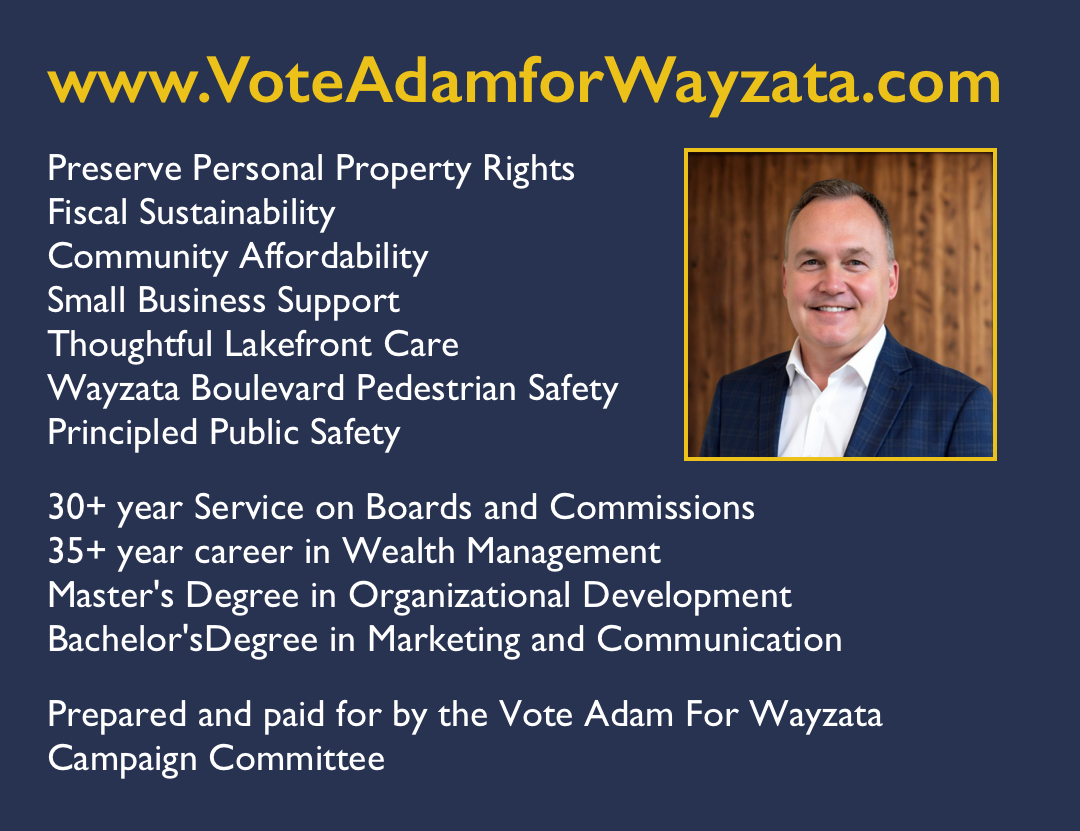
Four candidates seeking two seats on the Wayzata City Council discussed taxes, development, downtown businesses, short-term rentals, public safety and housing during a candidate forum Thursday, Sept. 24, at Wayzata City Hall.
Adam Elg, Dan Koch, Molly MacDonald and David Struck participated in the forum, hosted by the League of Women Voters of the Lake Minnetonka Plymouth Area in partnership with the Wayzata West Metro Chamber of Commerce.
The candidates are seeking two four-year City Council terms beginning in January. Election Day is Nov. 3.
Taxes and city revenue
How to limit the burden on Wayzata property taxpayers emerged as a recurring issue.
Koch said the city should exercise fiscal discipline and seek to hold increases in the general fund levy to 5% or less while continuing to adequately fund public safety and infrastructure.
Elg advocated diversifying city revenue, including consideration of app-based parking, fees for nonresident commuters using municipal parking and a food-and-beverage sales tax.
MacDonald also supported increasing revenue from sources other than property taxes, arguing that Wayzata’s popularity brings visitors who use city streets, sidewalks, parking and other infrastructure.
Struck said the city should look for additional revenue from existing assets, particularly the Wayzata Bar & Grill and municipal liquor operation.
The candidates split more sharply when specifically asked whether they support a food-and-beverage sales tax.
MacDonald said yes. Koch said he supports exploring the idea but wants additional study, including input from restaurants and hotels. Elg supported the concept but said revenue should provide specifically prioritized relief for businesses, commercial property owners and residents.
Struck opposed it.
“Food and beverage, I got to be honest, that’s a non-starter for me,” Struck said.
Development and downtown businesses
On development, Koch called for a more proactive approach, particularly along the east side of Wayzata Boulevard, rather than considering redevelopment only as individual projects are proposed.
Elg focused on residential design standards and suggested measures such as recessed, side-loading or rear-loading garages and porches to maintain the scale and character of neighborhoods.
MacDonald said the city’s upcoming 2050 comprehensive planning process will provide an opportunity to address development. She also called for examining permitted uses along Lake Street.
Struck said future development decisions should account for their effect on traffic and infrastructure throughout the city, not just conditions on an individual development site.
All four candidates identified the high cost of doing business in Wayzata as a concern.
MacDonald, who owns a Lake Street retail business, cited rent as a major obstacle. Elg pointed to commercial rents, property taxes, parking and year-round foot traffic. Koch discussed the property-tax component of commercial rents and the need for parking and traffic circulation. Struck also cited high rents and suggested the city explore ways to encourage businesses that fill unmet needs downtown.
Short-term rentals
The candidates also differed over short-term rentals. Wayzata adopted a one-year moratorium on new short-term residential rentals in March.
Elg said he opposes an outright prohibition and favors licensing, enforcement through nuisance regulations and revocation of licenses for violations.
Struck likewise favored licensing and inspections and suggested a tax on short-term rentals.
Koch said he does not support a citywide ban but believes the number of short-term rentals should be limited, with property owners held responsible for their guests and repeat violations potentially resulting in loss of a license.
MacDonald took a different position, saying her view had changed after listening to residents concerned about neighborhood character.
“The residents want to maintain their neighborhood character and that’s done by actually having neighbors,” MacDonald said.
She said she hopes the Minnesota Supreme Court will hear the city’s case and uphold its ban.
Flock cameras divide candidates
Candidates were also asked about public safety and Wayzata’s use of Flock automated license plate reader cameras.
Koch said he is comfortable with the Police Department’s current use of the cameras after discussing the system with Police Chief Jamie Baker.
MacDonald described herself as a skeptic and called for more public engagement, particularly over privacy concerns, while saying she believes the Wayzata Police Department has used the technology responsibly.
Elg opposed the cameras, citing privacy, data-sharing and what he called the potential for “mission creep.”
Struck also strongly opposed them and called for the city to end its use of the system.
Housing and other priorities
Affordable and workforce housing also drew attention. Elg and Koch emphasized preserving Wayzata’s existing naturally occurring affordable housing. MacDonald pointed to the city’s approval of accessory dwelling units and zoning changes intended to encourage preservation of existing homes.
Struck spoke personally about the issue, telling the audience he rents a two-bedroom apartment in Wayzata for $1,450 per month and worries that older apartment buildings could eventually be sold and replaced with more expensive housing.
Asked to identify their top priorities, MacDonald emphasized diversifying city revenue and protecting neighborhoods. Koch cited fiscal discipline and property taxes. Struck identified roads and traffic. Elg discussed revenue diversification before identifying the Wayzata Boulevard/County Road 101 corridor as a longer-term priority.
The approximately hour-long forum was moderated by Jackie Wells, a certified League of Women Voters moderator. Questions came from the public and forum organizers, with candidates generally given one minute to respond.
The League said the forum was intended to give voters an opportunity to hear directly from the candidates and that it does not support or oppose political parties or candidates.
Crane Island image was provided by the Lake Minnetonka Historical Society.
The Lake Minnetonka Historical Society will host its final history cruise event of the season Sunday, Oct. 4, with a three-hour trip exploring the historic shores of the Upper Lake.
“The Historic Shores of the Upper Lake” will depart aboard Paradise Charter’s Destiny II from the Port of Excelsior at 1 p.m. and return at 4 p.m.
Historians will narrate the cruise as it follows a route similar to those once traveled by Lake Minnetonka steamers Belle of Minnetonka and City of St. Louis. The route will pass through the Narrows and include the sites of the Halsteads’ “Hermitage,” Casco Point and the Upper Lake islands.
Tickets begin at $44.52. A cash bar with spirits and soft drinks will be available aboard the boat.
Advertisment:
The Lake Minnetonka Historical Society was formed in 2023 through the consolidation of the Excelsior-Lake Minnetonka Historical Society, Museum of Lake Minnetonka, Wayzata Historical Society and Westonka Historical Society. It maintains museums in Wayzata, Excelsior and Mound, along with its Research Archives in Wayzata.
Tickets are available through the Lake Minnetonka Historical Society’s online event listing. For additional information, contact the society at info@LakeMinnetonkaHistory.org or 952-474-2115.
The Wayzata City Council unanimously approved a $24.69 million preliminary budget for 2027 and a preliminary property tax levy of $7,694,025, a 6.25% increase over 2026.
Council members made clear, however, that they hope the final levy increase will be lower.
“Even though we’re at six and a quarter percent, I think we can all safely say up here at the dais that we’re looking to get that number fairly measurably lower than that,” council member Alex Plechash said before the Sept. 15 vote. “We’re kind of targeting five percent. We’re not sure we can get there, but certainly less than 6.25.”
Mayor Andrew Mullin said that direction has been consistent since the budget process began in July and that the preliminary levy leaves the city some room as the council continues its work.
The preliminary levy must be certified to Hennepin County by Sept. 30. Once set, the council can lower the levy before final adoption in December but cannot increase it.
The council had directed staff at its Sept. 1 workshop to bring the preliminary increase down to no more than 6.25% over the 2026 levy.
The $7,694,025 preliminary levy consists of $7,167,000 for the General Fund, $493,500 for city infrastructure and $33,525 in debt service related to an equipment certificate for the city’s ladder truck.
For a home with a median taxable value of $1,170,150, city staff estimated the city portion of the property tax bill would increase by about $59 if the property’s taxable value remained unchanged. If the taxable value increased by 5%, the estimated increase would be approximately $207.
Staff estimated Wayzata’s 2027 city tax rate at 20.05%. In a comparison presented to the council, Wayzata’s rate was below most of the other Lake Minnetonka-area cities included, with Orono lower.
The city’s preliminary General Fund budget is $10,425,858 and assumes a 6% increase in operating expenses.
Among the costs identified by staff are a full year of wages and benefits for the full-time fire chief, a new investigator position in the Police Department, a seasonal Community Development intern, increased personnel and insurance costs, and the transfer of the Cable and Cemetery funds into the General Fund.
The city’s stated goals for the 2027 budget are investing in public safety personnel and minimizing the impact on residents.
In addition to the General Fund, the preliminary budget includes $1,328,666 for water, $2,113,254 for sewer, $307,155 for stormwater, $457,506 for solid waste, $8,616,577 for municipal liquor operations, $632,646 for the marina and $810,141 for motor vehicle licensing.
Combined, the preliminary budgets total $24,691,803.
Unlike the General Fund, which receives much of its revenue from property taxes, the city’s enterprise funds are supported by user fees. The city reviews those fees annually to provide revenue for operations, cash-flow needs, reserves and replacement of infrastructure.
The preliminary budget follows council workshops held June 2, July 7, July 21, Aug. 18 and Sept. 1.
The council is scheduled to review the 2027-2036 capital improvement plan Oct. 20 and receive a final budget update Nov. 24. Adoption of the final levy, budgets and fee schedule is scheduled for Dec. 1, followed by adoption of the capital improvement plan Dec. 15.
Hannah Tubbs pauses for a photo with her favorite celebrity – Chef Gordon Ramsay. Image courtesy Christopher Tubbs.
For Hannah Tubbs, Gordon Ramsay’s visit to Wayzata came with a chance to meet her favorite celebrity chef.
Hannah met Ramsay during his visit to Maggie’s Family Restaurant this week. Her father, Christopher Tubbs, a producer at WCCO Radio, shared the photo of his daughter and Ramsay with Wayzata.com.
Outside, residents gathered in front of Maggie’s hoping for a glimpse of Ramsay, while production trucks, television equipment and crew members filled the area around the restaurant as filming continued.
A crowd gathers to see Gordon Ramsay at Maggie’s. Photo Dan Gustafson.
Wayzata resident Mark Wittig was among the local residents who gathered outside Maggie’s hoping to catch a glimpse of Ramsay during the production. Wittig photographed Ramsay inside and around the restaurant, as well as some of the activity surrounding the filming, and provided the images to Wayzata.com for publication.
Photo by Mark Wittig.
Maggie’s had given customers advance notice that something was changing.
“We apologize but Maggie’s will be closed to the public 9/18-9/22. Please come check out the new look when we reopen.
Thanks.”
Photo by Mark Wittig.
The restaurant did not mention Ramsay in the Facebook announcement.
Production sought Wayzata and Lake Minnetonka footage
Wayzata.com received another indication of the production more than a week earlier.
On Sept. 11, a woman who identified herself as Antonia Green left a voicemail saying she was a producer for a “Gordon Ramsay Led Series” and that the production planned to film in downtown Wayzata and the surrounding area during the week of Sept. 14.
Green was trying to reach someone at the Wayzata Yacht Club about a sailing event scheduled for Sept. 18-20.
In the voicemail, she explained that the production was interested in footage showing the landscape, historical areas and Lake Minnetonka. She said producers hoped to obtain B-roll of the sailboat race for an introduction showing viewers where the program was taking place.
Photo by Dan Gustafson.
The call shows the production was looking beyond Maggie’s for footage establishing Wayzata and Lake Minnetonka as the setting for the episode.
A Wayzata restaurant since 1979
Maggie’s was established in Wayzata in 1979 by Nick Homan and is now operated by his son, Scott Homan. The family restaurant serves breakfast throughout the day along with lunch, pizza and Italian and American dinners.
Photo by Dan Gustafson.
The title of the Gordon Ramsay program being filmed in Minnesota has not been publicly confirmed. The producer who contacted Wayzata.com identified it only as a Gordon Ramsay-led series, and MPR reported that Fox Entertainment had not identified the program.



You must be logged in to post a comment.